Sunday, January 25, 2009

Winter Blooming


Lenten Roses in my back shade garden this week and the exquisitely perfumed winter jasmine.

"The courage of some small and apparently fragile flowers never ceases to amaze me. Here are we humans, red-nosed and blue-cheeked in the frost and the snow, looking dreadfully plan; but there are the little flowers coming up, as brave and gay as can be."--Vita Sackville-West

Couldn't have said it better myself.

Monday, January 19, 2009

Can we talk about writing about talk...?

All the information you need can be given in dialogue.
- Elmore Leonard

I taught a seminar on Writing Dialogue for the Writing Room on Saturday. Preparing and leading a writing seminar on a craft element always turns out to be a big refresher course for me.

Here are a few notes from the seminar:
What is dialogue? Dialogue is conversation between two or more characters.
1. One mark of good written dialogue is that it is doing more than one thing at once:
• Advancing the plot
• Revealing character
• Providing “subtext”

Subtext
is what's not said but implied. Dialogue is often a mask for unexpressed feelings. Or even for lying. People frequently don't say what they mean. It makes for interesting dialogue if the reader knows that someone isn't saying what she means, or is lying. It creates tension.

2. What is not said is as revealing as what is said, especially regarding emotion. People in crisis are often at their least articulate. Think about it: The rhythm of speech changes according to our emotions. An angry person will be short and sharp. A person in love will be long and languid and dreamy.

3. As Francine Prose mentions in her book, Reading Like a Writer, dialogue in fiction is better than "real" dialogue. Fictional dialogue should be an improved, cleaned up, compressed, economical, and smoothed-out version of the way people talk. And yet, it should sound "natural."

4. Dialect is challenging and easy to overdo. "Dialect should always be achieved by word choice and syntax, and misspellings kept to a minimum. They distract and slow the reader, and worse, they tend to make the character seem stupid rather than regional." --Burroway, WRITING FICTION

Good examples of dialect (where syntax makes dialect clear): "Don't rush me none."
"Run up yonder and tell her."
Bad example: "Doan rush me nun, Ah be gwine." (caricature)
Ron Rash (ONE FOOT IN EDEN), Richard Price (LUSH LIFE) and Annie Proulx ("Brokeback Mountain") are writers who are masters of dialect.

5. A few ways to improve your dialogue writing skills:
Eavesdrop. Start paying close attention to people’s conversations in public places. Write down snippets or intriguing lines in a journal.
Read your dialogue aloud "to make sure it is comfortable to the mouth, the breath, and the ear. If not, then it won't ring true as talk." --Burroway, WRITING FICTION.
Also, have people read your dialogue to you. You’ll be able to hear the rhythm and cadence of the sentences, how easy it is to pronounce the words and syllables, how long each character’s dialogue is.
Keep Practicing. The best way to improve dialogue writing skills is to read it (you’ll learn to spot and pay attention to authors who are good at writing dialogue) and to write more dialogue. The more you practice writing it, the more you’ll come to understand the cadence, rhythm and timing of natural-sounding dialogue.

Oh, and Happy MLK Day everyone.

Monday, January 12, 2009

Good News Monday

It's Monday, the perfect day to post some great news to start the week off. There's a lot of good going on in the world, ya'll:

1. Fiction Readers
Fiction reading is UP UP UP according to the newest report form the National Endowment for the Arts. Here's the NYT article, "Fiction Reading Increases For Adults" with the details: ..."the proportion of overall literary reading increased among virtually all age groups, ethnic and demographic categories since 2002. Increased most dramatically among 18-t0-24-year-olds, who had previously shown the most significant declines." Yay.

2. Vegetarians. I love that the younger generation is SO into caring for the Earth. Young folks are the new stewards of the environment who take their roles to heart. Here's more from ABC News about a new report from the Government: 1 in 200 kids are vegetarians-- the main reason? Concern for animals. Oh, my children, you rock!

3. Spring Bulbs
Those harbingers of spring-- and hope--the narcissus and daffodil bulbs are up...in January. Elizabeth, a character in my first novel, The Garden Angel, thought of them as "green fingers reaching skyward." Here's an emerald hand, beside the stone possum, from my back garden:

Thursday, January 8, 2009

The B word


Now HERE'S an adjective--in a headline, to boot-- that I don't think has ever been used to describe me... and without a trace of irony, too.

Maybe it's just the company you keep.

All kidding aside, I'm grateful to have been included
in this article.


Photo credit: Josh Norris, TALK maga
zine

Tuesday, January 6, 2009

Eager Reading

I can't WAIT to get my hands on the newest books from two of my favorite authors:


LARK AND TERMITE by Jayne Anne Phillips. Her novel, MACHINE DREAMS, is a treasure; a book I reread for its lyrical beauty. Reading Phillips' fiction always reminds me of the power and sheer pleasure of language. Here's the glowing review of Lark and Termite from Michiko Kakutani in today's NYT...and here's an excerpt.

and

THE RED CONVERTIBLE by Louise Erdrich, selected and new stories from a prolific writer whose work seems to get better and better.

Friday, January 2, 2009

Taming the Monkey Mind

Happy 2009.

I spent a couple of golden hours on New Year's Day at a meditation class, "A Yogic Approach to Making and Keeping Resolutions for Constructive Change" taught by Dan Salmon and Jan Maslow.

I usually make typical New Year's resolutions and goals based on something I want to change or improve, but in the last couple of years it's occurred to me there's a better way of goal-setting.

First, I've discovered it's always better to work from your strengths, talents, passions, than your weaknesses. (The best managers, teachers, leaders know this.) Focus on the positive and it strengthens and brightens, eclipsing the negative. Spending a lot of time on correcting weaknesses drains energy and wastes time. In Zen-speak, it's not accepting What Is. Besides, what you resist, persists. (Mother Theresa: "I was once asked why I don't participate in anti-war demonstrations. I said that I will never do that, but as soon as you have a pro-peace rally, I'll be there.")

Goal setting from a yogic perspective emerges during meditation, from a quiet mind.
I know, I know. Easier said than done--but practicing does help tame the "monkey mind." And I have a very hyper jittery monkey mind. The kind that jumps and pirouettes and hisses and frisks passersby for peanuts with its little leathery hands.

Here are the steps for goal setting, as our teachers explained yesterday:

1. Finding Stillness. Let go of all concerns about goals; be open to the ever-present stillness, calm and joy within.

2. Goals emerging from stillness. Observe--without judging-- what goals/visions emerge from your deepest consciousness.

3. Dealing with obstacles from a place of inner stillness. Without reaction or judgment, see what negative "stories" you are telling yourself (from that incessant narrator in your head, that chattering little monkey) about who you are and what obstacles you think may present themselves on the way to achieving your goals. Replace the negative stories with positive ones.

4. Creative visualization. When you are calm and centered, experience what it feels like to have achieved the goal. What does the success feel like now? Picture it as if it is already a reality. A number of professional athletes often use such visualization techniques to improve their performances. Modern neuroscience supports the power of visualization.

5. Practice. Develop a regular practice of going within, centering, and then, from that place of calmness, use creative visualization to reinforce the progress toward your goals.

Tuesday, December 30, 2008

Beans & Greens


Ah, New Year's Day. One of my favorite holidays. Better than Christmas or Thanksgiving. There's none of that frenzied pace, but a day of R&R--at least in my house: Relaxation and Resolutions.

Relaxing-- post-party-- from the night before (with maybe a hair-of-the-dog Mimosa to kick off the day.) And then a languorous afternoon of reflection and writing down (or about) the year's resolutions.

And of course, on the stove, big pots of collard greens (seasoned with olive oil, garlic, crushed red pepper) and black-eyes peas (soaked overnight, then cooked for hours). Corn bread baking, and potatoes mashed and buttered. Also, something chocolate.

Beans and greens on New Year's Day bring good fortune and wealth-- the "greens" are cash, the peas are coins. I've heard this traditional menu started after the Civil War, when collard/turnip/mustard greens and black-eyed peas were about the only crops left in the South.
I wouldn't start a new year without it.

Friday, December 19, 2008

Every family has one. A little embarrassing perhaps, baffling to outsiders, but it persists nonetheless.

In my family it is pink and cold.

Read the rest over at A Good Blog is Hard to Find, where' I'm guest blogging. Happy weekend.

Thursday, December 18, 2008

The Writing Room: January Classes


The Writing Room is a program we started here in Upstate SC offering classes to writers of all levels. It's sponsored by the nonprofit Emrys Foundation. January's offerings include a seminar on dialogue by yours truly and a 9-week advanced class, taught by novelist Ashley Warlick, for folks who have a manuscript. Here's a link for more information.

SEMINARS AND WORKSHOPS, WINTER 2009

Writing Dialogue
with Mindy Friddle

When dialogue in fiction and creative nonfiction is working, it helps to create rich, believable characters and drives the story forward. So how do you write believable dialogue? When should we hear a character speak? And how might dialogue be used to complicate a character or story? In this seminar, we'll examine dialogue in several fiction and nonfiction pieces. We'll discuss how to create conversations between characters that sound spontaneous and lifelike--not monotonous. Participants will be invited to do in-class writing exercises designed to help write sharper, richer dialogue that rings true, reveals character, creates tension, and adds depth through subtext. This is designed to be a fun, informal seminar for writers at all levels who are looking for fresh approaches to writing dialogue.

Level: All levels, Beginner to Advanced
Saturday, January 17
2:00- 4:00 pm
Location: Innovate Building Conference Room, 148 River Street, Greenville, SC
Fee: $25; $20 Emrys member

Works in Progress: Focusing on Your Book Length Manuscript
with Ashley Warlick

This popular class is for experienced writers with a book-length manuscript of either fiction or nonfiction in progress. Each student will submit 40 to 50 pages of their work to be closely read and carefully considered by both the instructor and the group, providing the center of one full class period's workshop. Through constructive, frank critique, both given and received, students will learn to identify and address what works in a manuscript and what does not. Expect to come away from the class with specific reading assignments and concrete recommendations on how to improve your novel, memoir, or collection.

Level: Advanced
This workshop may be taken more then once.
9-week class, 3 hours each class,
Starts January 20
Tuesdays,6:00 - 9:00 p.m.
Location:Furman University, Modern Languages Department
Fee: $360; $340 Emrys member
Class size limited to 8 people.
Registration [and the waiting list] for this class closes January 16.


Seminars and Workshops, Spring 2009
[To be announced soon]

Monday, December 15, 2008

Writing a Novel in 42 Minutes...per day

The December issue of my Warren Wilson MFA alumni newsletter was chock full of great stuff...but I just had to share this profile of novelist Vyvyane Loh, author of Breaking the Tongue. Doctor, choreographer, animal rescuer and writer-- Vyvyane's secret to writing novels is carving out 42 minutes for writing every day. Read this interview ( a great conversation between two writers conducted by fellow WW MFAer Cindy Phoel), and it will be hard to complain about not having enough time to write. Really--it's encouraging.

Guggenheim Fellow & Wally fiction writer
Vyvyane Loh talks about her 42 minutes of daily writing and her 12 pet bunnies.

When the Boston Globe profiled Vyvyane Loh (Warren Wilson MFA fiction ’01) on the 2004 publication of her first novel, Breaking the Tongue, they spoke of her as a dedicated physician, accomplished choreographer, and critically acclaimed novelist. “She’s All That,” the piece was titled, and for those of us who know Vyvyane, this seemed like an apt title. Four years later, we find Vyvyane collecting a Guggenheim Fellowship while she puts the finishing touches on her second novel—proving that she’s all that, and then some. In a conversation with her Wally friend and classmate Cindy Phoel (Warren Wilson MFA fiction ’03), Vyvyane talks about her 42-minute-a-day writing habit and her secret desire to be—of all things—a poet!

Cindy: A few months ago, we were talking about whether—and how much—we were writing. I was failing to get enough writing done, and you told me I was setting my goals too high. You shared with me your own strategy, which mirrors the strategy you use with your patients who are trying to lose weight. It’s a strategy I think every writer strapped for time (certainly all moms!) should know.

Vyvyane: I try to set laughable goals. 20 minutes of writing per day, or 40 minutes if it’s an easy day. I tell my patients who are trying to lose weight to walk for NO MORE THAN 5 minutes for the first week of their weight loss program, and they always come back saying they felt so silly only exercising for 5 minutes that they walked for 10 minutes, or 20, or even 30 minutes. The extra time is fine, but you get points for doing the minimum, which is how I try to set up my writing time as well. I write for 42 minutes each morning—the extra 2 minutes makes me feel very virtuous. I use a timer and there are lots of days when I have one eye fixed on the seconds ticking away and one eye on the screen, and when the timer goes off—relief! I’m done! Yippee yay!

Can you honestly say that your second novel—which is quite long, perhaps 500 pages—was written on 20 or 42 minutes a day? Or were there periods where you were writing more than that?

I did write lots in spurts—50 pages over 3 days, 25 pages over a couple of days, but most of it was written in my 42 minutes per day!

I am reminded of the spin class you used to teach—a hard-driving hour of cycling at 8:00 on Saturday mornings. One day, I found myself sitting in front of these two burley guys, who obviously thought this would be a walk in the park. They chit-chatted their way through the warm up and into the first song, and then after a bit of panting, I heard, “She’s kicking my ass!”

Yeah, I figured we should work as hard as possible for the hour and then forget about it for the rest of the day. It’s not too different with writing. There’s so little time to write, so I try to go full steam ahead for the 42 minutes and then not agonize over not doing more for the rest of the day. Remember our motto of keeping the small picture in view and forgetting the big picture. I think you told me that one time, and I keep reminding myself now when I feel overwhelmed: just stay with the small picture.

It’s a bit paradoxical, isn’t it, that you say you focus on the small picture, and yet your work is decidedly big picture. Your first novel was set during the Japanese invasion of Singapore during WWII. And this second novel tackles suffering in Rwanda, Haiti, and Afghanistan. Time and place and how your story reflects or interprets the world are very important to you. Can you talk about this?

Yes, I suppose I do keep the big picture in mind when I write. I am always conscious of how various events in my book are seen through the lens of what is happening in the world. I have never forgotten what I learned when I was a Classics student in college: that when Agamemnon left Greece to fight in the Trojan War, he chose—not a general, not a politician—a poet to rule in his place, because he felt that the poet was the moral conscience of the people and that this conscience would steer his kingdom on the right path. That really stuck with me, and it’s always at the back of my mind when I’m writing.

Let’s talk for a moment about starting places. We’re often encouraged to start with character or place—even an image that ignites us. For you, though, the impetus is theme. Can you talk about this?

You’re right that I don’t start with character or plot. I tend to start with ideas and yes, I suppose, theme. I spend a lot of time reading non-fiction on things or ideas that fascinate me and sometimes they captivate me so much that I want to write a book about them. And often, it’s because there’s something that I’m struggling with—a concept or an idea that I want to embrace but can’t for whatever reason—that I end up writing about it.

It feels a bit narrow to categorize you as a fiction writer. With Breaking the Tongue, you were certainly a historian. And with your new novel, you have taken on the role of translator—a role I think you’ve particularly enjoyed.

I’ve been interested in literary translation ever since I took a translation seminar with Rosanna Warren in college and read George Steiner’s After Babel. I still go back to that book every year, believe it or not. I taught myself Portuguese because I wanted to translate Drummond and Pessoa and Machado de Assis. My current book deals with translating a poem by Paul Celan. I wrote poetry when I was in college. I only started writing fiction about a year and a half before Warren Wilson. I was tempted to apply in Poetry but chickened out. There are lots of things I would love to get round to writing if I had the time (or if Oprah would give me a break): poetry, more translations, plays.

One last question: You have no fewer than twelve bunnies in your house. These are animals that you’ve fostered or adopted when they needed homes. Is this yet another example of everything-Vyvyane-does-she-does-with-intensity, or is this your moral conscience at work? Or is this, perhaps, your human attraction to things soft and fuzzy?

I have 12 bunnies, 1 dog and 1 parakeet, 1 hus-bun. Cleaning up after them takes 2 hours of my day! (Well, I’ve sort of trained the hus-bun to fend for himself). I’m a big animal advocate. I think it’s part moral conscience—I hate the way we’ve messed up Nature and blame her for everything. I mean, you’ve heard of people who move to the wilderness and then complain about those damn bears in their garbage all the time and then plot to shoot them to make the place “safer.” The bunnies I’ve adopted were mostly Easter dumps. They have wonderful personalities and one of them, Oolong, is my personal paper shredder. I show her stuff that I’ve written that I’m not too hot about and she chomps on it and poops it out later. Her way of saying, “This stuff is s**t.” Literally.

Wednesday, December 10, 2008

Will Write for Food:the return of the FWP

Saul Bellow. John Steinbeck. Zora Neale Hurston. Ralph Ellison. Stud Terkel. They're all famous for participating in The Federal Writers' Project (FWP), which, as you recall, was a United States federal government project to fund written work and support writers during the Great Depression. It was part of the Works Projects Administration, a New Deal program. It was a fabulous success.

With waves of laid-off journalists (the Chicago Tribuen going under? WTF?)and talented writers, historians, editors, researchers around these days, there's word it might be time for another FWP.

Here's an article on why President-elect Obama should resurrect the WPA and bail out laid-off journalists and a cheeky essay on how a modern FWP might work (bottom line: writers aren't in it for the money anyway. They are compelled to write. They can't help it.)

I think this is an excellent idea. I just have one question. Where do I sign up?

Monday, December 8, 2008

captivating captions


My interest was piqued a couple of weeks ago by the above cartoon, because a caption flew into my head when I saw it:
But I thought you always wanted a lot of kids.

Since then, I turn to to the back of each new issue of the New Yorker so I can see who won the weekly cartoon caption contest. In fact, I've started to spend way too much time trying to think up pithy, biting captions. Some people have crossword puzzles or that sudoku math thingy, but this is a lot more fun. It's also way harder.

Who would have known the contest has its own obsessive subculture? Here's an essay in Slate about how to enter and win. Each week something like 6,000 people submit captions. Some really lucky (or long-suffering, depending on your point of view) staffer's sole job is to pluck out 50 from that brier patch, which are then weeded down to three finalists by a Wise, Knowing Editor. The public/readers are invited to vote on the winner.

I didn't send it in the goat cartoon caption because it was too late. So I just decided to wait until the next week's cartoon, not knowing that the chance of an ideal caption popping in your head is a rare, joyful occurrence. Like falling in love. Or having your book optioned for film. Or finally voting for a guy who actually wins the White House. So. Here is the actual caption winner and two finalists for that cartoon:

First Place

"Come sweater season, you'll be back."

Second Place

"Could you bring me back a goat?"

Third Place

"You're the one who left your fertility drugs on the counter."

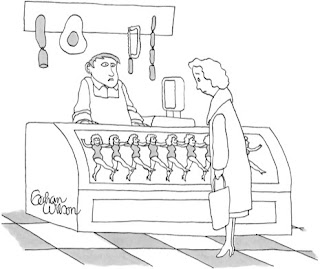
A couple of weeks ago, this cartoon appeared, and my caption--that I actually submitted-- was: It's our new line of free-range breasts and thighs.
I'm sure I was overly fond of the "line" pun--as in dance/ chorus line... But it didn't make it out of the thousands of other brilliant witticisms. I have to admit the three finalists have been blessed by the caption fairy. My favorite: I'd suggest you keep them away from the gingerbread men.
eXTReMe Tracker