Monday, April 28, 2008

Cover Story part 1

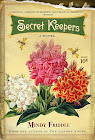
I need your help. I'm casting about for images and art and objects that capture the feel of Secret Keepers, my forthcoming novel. I'm no graphic artist...and I'm so happy to foist off--I mean delegate-- jacket design to the professionals. But my editor agrees that bringing along some ideas that evoke the novel is a splendid idea. For The Garden Angel, I helped track down the featured porch--and actually took the photo myself. I wanted something definitely UNpristine and forlorn and beautiful--sort of ruined finery. And so I emailed my humble jpg, and the true artists then worked their magic and designed around it.

This time, I'm attracted to vintage seed catalogs and botanicals. Secret Keepers is about the emergence of a swallowed-up lost garden--the legacy of a tragic planthunter.

I love this:

Burpee, 1898

And also this--because of the landscape of the town:
Nurserymen's Specimen Book, 1875

And this:
Burpee, 1900

Here is the album for more examples and larger views.

Vintage Botanical Illustrations, Prints, and Seed Catalogs
What do you think? Do tell.

Thursday, April 24, 2008

The Jane Austen Book Club


After reading Karen Joy Fowler's novel The Jane Austen Book Club, I can see why this proved to be a breakout book for the author and popular with book clubs. It's witty--Fowler has a unique voice--and of course, it is (duh) about a book club.

Told in third person POV, we spend time in the mind of each character, who are all connected through the monthly meetings and discussions of Jane Austen. Very clever structure, too: the meetings often begin, briefly, in first person plural ("We really could not approve of someone who showed up with an obviously new book, of someone who had the complete novels on his lap when only Emma was under discussion. Whenever he first spoke, whatever he said, one of us would have to put him in his place"), before narrowing down to one character's point of view and backstory, told in "close" third person POV. Occasionally, a character addresses the group in an extended scene/flashback told in first-person POV ("I took up tap and ballet at Miss Olive's. I was the best dancer there, which didn't mean squat, but gave Mother ideas"...)
All of which provides a seamless, multifaceted look at this constellation of characters.

Monday, April 21, 2008


In this issue of Poets & Writers magazine: An informative, funny, and inspiring interview with Nat Sobel on agenting, editing, publishing, writing and Sobel Weber, "one of the top boutique literary agencies in New York City" :

"When you spend any amount of time with Sobel, talking about books and publishing, which now have been his lifeblood for almost fifty years, you are confronted with an obvious contradiction: He is also one of the most forward-thinking agents in the industry..."
Read the full interview here.

Tuesday, April 15, 2008

Recommended: The Great Man & A Blow Up Doll


Plucked from my towering TBR list: The Great Man, a novel (by Kate Christensen) I just finished and thoroughly enjoyed. Little in the way of exposition, and lots of dialogue--- strong dialogue. Here's an excerpt. Btw, The Great Man won the 2008 PEN/Faulkner Award for fiction.

Also, my Netflix queu is one shorter. Lars and the Real Girl arrived and we watched it tonight. The "real girl" is one of those blow-up sex dolls you can order over the internet. But it's not that kind of movie--it's PG-13 (but definitely for adults). Quirky--that overused adjective is useful here. Oddly fulfilling. A sort of modern-day Harvey. Well written, well acted, well done.Written by Nancy Oliver, of Six Feet Under fame (God, I miss that show. )

Sunday, April 13, 2008

Doctorow Info


New York magazine, as part of its 40th anniversary issue, interviews E.L. Doctorow, author of Ragtime, one of my all-time favorite novels.

A short but intriguing Q&A. Regarding research, for example: "When you’re working well, you don’t do research. Whatever you need comes to you." Literally...
Read the full interview here.

Thursday, April 10, 2008

Author to Author: Beanball


From my "Author to Author" column appearing this week in the Greenville Journal:

The Author: Gene Fehler
The Book: Beanball (Clarion Books)
The Events: Gene Fehler will sign copies of his new young adult book, Beanball, on April 12, from 2 p.m. to 4 p.m. at Fiction Addiction, 3795 E. North St, Ste 9 and on April 19, at noon, at the Open Book, 110 S. Pleasantburg.


Gene Fehler has been in the writing game for years. The South Carolina poet has been published in more than 300 magazines, including The Nebraska Review and Saturday Evening Post. His work has appeared in children's publications such as Highlights, Guideposts for Kids, and Sports Illustrated for Kids. His poems have been read aloud on National Public Radio and HBO.

Now he’s hit one out of the park. The Seneca resident’s first young adult novel, Beanball, is drawing fans. “I don't know if it's because it's for a young adult audience or because it's been released by a major publisher (Clarion Books, a division of Houghton Mifflin), but I've already gotten much more response since its February release date than any of my other seven published books,” he said.

Although it is marketed to middle-school audiences and older, many reviewers have noted that a reader doesn't have to be a fan of either baseball or poetry—or a young adult—to enjoy Beanball. The novel’s unusual structure—free-verse monologues by 28 different voices—helps make it a thought-provoking and suspenseful read. The idea for the pivotal event in the novel, Fehler said, came from his own high school days. “One of my best high school friends had a promising baseball career as a pitcher that ended in college with an arm injury. I thought that would be a good conflict to base a novel on: how can a boy cope with the loss of his major league dreams? I decided to make the loss even more dramatic and sudden by having a high school center fielder (Luke ‘Wizard’ Wallace) struck in the face with a pitched ball and blinded in one eye.”

The wild pitch, or “beanball,” that shatters Luke’s skull changes his life. The injury also affects the lives of the 28 narrators—including Luke’s best friend, his girlfriend, family, teachers, teammates, and doctors. “I chose multiple narrators because I've always been fascinated by how in fiction the story changes depending on what character is telling it,” Fehler said. “I found the process really interesting, because I had become each of the narrators, to put myself into their mindset. I tried not to speak for them, but to let them talk and record what they were thinking and saying.”

Take, for example, the umpire:

It’s the worst sound I’ve ever heard
in all my years of umping.
Oh, I’ve heard plenty of pitches hit a helmet.
But this . . . this fastball, up and in
This one hit bone, right in the face.
Not even a scream or grunt from the kid.
He went down like he was shot.

The free verse format with multiple narrators, “let me introduce a number of sub-plots-- a teammate's feeling of guilt, an umpire's shock, a father's anger, a mother's questioning of her faith, a girlfriend's shallowness, a coach's bitterness, an opposing player's jealousy, a friend's loyalty,” Fehler said. A more conventional approach wouldn’t have made that possible, he said.

Critics have been kind. Kirkus, in just one of many glowing reviews praising Beanball, says of the novel: "Each voice maintains its individuality with all the voices combining seamlessly to tell a powerful story. In Fehler's debut novel, he succeeds at every level." On June 7, Fehler will be heading to the Smithsonian in Washington, DC, courtesy of his publisher, where the American Art Museum will be is hosting an event in which the Washington National major league baseball team will be reading to children and young adults. Fehler will be on hand to sign copies of Beanball.

But the business of promotion hasn’t distracted Fehler from working on more books for children and young adults, “some in verse, some in free verse and some in traditional prose fiction.” While his previous six books were published by four different publishing houses without the help of an agent, after Simon & Schuster published Goblin Giggles (2005), Fehler said he found an agent. She sold Beanball within a few months. The same publisher also bought Change-Up, an illustrated book of baseball poems for kids, illustrated by Donald Wu, forthcoming in 2008 or early 2009. “As a writer, one can't spend time waiting for publishers to respond,” he said. “The only thing to do is keep writing and try to make each book better than the one before.”

And enjoy a well-earned winning season.

Wednesday, April 9, 2008

Wild Gardens of Prose


I had to thin out my my lettuce the other day. It seems counter-intuitive-- you toil and nurture and sow seeds and when the tender darlings sprout, you pluck half of them out. If you don't, your bunch fails to thrive, starved for air and space. You get an overcrowded, anemic crop. And no salad.

Editing is like that. Words and images are strangled without some air and space.

"Kill Your Darlings," Faulkner advised writers.

Samuel Johnson said, "Read over your compositions, and wherever you meet with a passage which you think is particularly fine, strike it out."

More pithy quotes:

“The most essential gift for a good writer is a built-in, shock-proof shit detector.”
– Ernest Hemingway (1899-1961)

“The most important lesson in the writing trade is that any manuscript is improved if you cut away the fat.”
– Robert Heinlein (1907-1988)

“I believe more in the scissors than I do in the pencil.”
– Truman Capote (1924-1984)

“I have been correcting the proofs of my poems. In the morning, after hard work, I took a comma out of one sentence…. In the afternoon I put it back again.”
– Oscar Wilde (1854-1900)

“A burro is an ass. A burrow is a hole in the ground. As a journalist you are expected to know the difference.”
– United Press International Stylebook, cited by Bill Walsh in “The Elephants of Style”

“A writer is a person for whom writing is more difficult than it is for other people.”
– Thomas Mann (1875-1955)

“Every word that is unnecessary only pours over the side of a brimming mind.”
– Cicero (106-43 BC)


Friday, April 4, 2008

A Good Blog is Hard to Find

I'm guest blogger today over on A Good Blog is Hard to Find:

Today marks 40th anniversary of the assassination of U.S. civil rights leader Martin Luther King, Jr.

Although I was just a three-year-old kid in South Carolina when he was shot and killed in Memphis, I grew up--like most of us-- learning more and more about the incredible impact he had on the South, on the country, on the world...

read the whole thing here at A Good Blog is Hard to Find.

Monday, March 31, 2008

Skip This One

Overall, this Booker-Prize winning novel disappointed.

Despite many stunning sentences, I didn't find "the transformative power of Enright's language keeps the story's freight from burdening the reader," as this reviewer wrote. This dark novel's protagonist, Veronica, is so full of self-pity and bitterness, it is hard to sympathize, much less find interest in her dilemma about a murky sexual abuse memory from childhood. No light refracted in this bitter ale of a story, and I couldn't help but think of Charles Baxter's dead-on essay, "Mistakes Were Made," from his collection Burning Down the House. In the essay, Baxter skewers Jane Smiley's A Thousand Acres, a "moody novel" which also features a "recovered memory scene."

Says Baxter:

The characters' emotions are thus ordained, and the narrator gathers around herself a cloak of unreliability as the novel goes on...the mood itself often seems impenetrable, because the characters, including the men, are not acting upon events in present narrative time but are reacting obscurely to harms done to them in the psychic past from unthinkable impulses that will go forever unexplained...[my emphasis]
Among the accolades for this book, my own reaction comes closer to this reviewer's:

Veronica is so self-pitying and self-absorbed that no clear detail about anyone in her life emerges from the endless me me me. Most of her siblings (there are 11 of them) are just names on the page, and even [her brother] Liam is close to a cipher.

Veronica, meanwhile, puts the saddest, ugliest spin she can on any subject that occurs to her — whether it's her grandmother Ada's "overused pubis" or her husband's erotic imaginings — only to back away after a page or two and concede she has no real information. Again and again she comes up with generalizations ("History is only biological — that's what I think") or summations of character ("For a woman like Ada, every choice is an error, as soon as it is made") that have nothing to support them.

Hankering to read powerful, dark tales of rage and beauty? I recommend anything by Mary Gaitskill.


Saturday, March 29, 2008

Shout Out for Bulls Island


There's an interview with NY Times Bestselling author Dorothea Benton Frank up on A Good Blog Is Hard to Find about her latest novel, Bulls Island. For those of you who aren't familiar with it, Bulls Island is one of the few protected, pristine barrier islands left on the SC coast:

Q. What was the inspiration for Bulls Island?

A. Inspiration for BULLS ISLAND arrived the same as it did for my otherbooks - it's that little voice in your head that says What if? I wasreading something in the NY Times about protected islands beingdecommissioned and made available for public use and I thought well,
that could never happen to Bulls Island. Or what if it did? And how
could that actually unfold?

Then I started thinking about the story and knew it should be a struggle
to save it, to preserve its pristine habitats, and that the struggle
should expand to the people determined to develop it versus the people
to whom it was unclear if this was a sound idea - was it environmentally
ethical? Or was it just another case of greed? And what if those opposing teams were comprised of star crossed lovers, long separated and perhaps by a tragedy? What if they happened to bump into each other across a conference table?

And what if every character in the story had a secret - some bull they
were hiding and on the bull scale it could go from zero to a billion?

That's how the process starts . . .


Read the full interview here.

Thursday, March 27, 2008

Ragged hollow first drafts


I like what Walter Mosley has to say about revision here on his website:

"First drafts are ragged hollow things that need to be revised, rephrased, and rethought again and again until something transcendent occurs on the page; until the story becomes life."

He notes that, for him, rewriting has become second nature, even for emails and memos, and that constant rewriting "borders on obsession, but there's nothing wrong with that."

I agree. And I think the more you write, the more skilled you become at rewriting...spotting the glimmers of gold among the sludge. I've found revision is the real work and real pleasure of writing fiction; and when you hit "the zone," where all time stops and your focus is in another dimension...that's da bomb.

btw, I regularly recommend Walter Mosley's no-nonsense yet inspirational book This Year You Write Your Novel to folks in my workshops. It's so very wise: "Your first draft is like a rich uncultivated field for the farmer: it is waiting for you to bring it into full bloom."
Here's the opening:

The first thing you have to know about writing is that it is something you must do every day—every morning or every night, whatever time it is that you have. Ideally, the time you decide on is also the time when you do your best work.

There are two reasons for this rule: getting the work done and connecting with your unconscious mind.

If you want to finish this novel of yours within a year, you have to get to work! There’s not a moment to lose. There’s no time to wait for inspiration. Getting your words down on the page takes time. How much? I write three hours every morning. It’s the first thing I do, Monday through Sunday, fifty-two weeks a year. Some days I miss but rarely does this happen more than once a month. Writing is a serious enterprise that takes a certain amount of constancy and rigor.

But will and regularity are only the beginnings of the discipline and rewards that daily writing will mean for you.

The most important thing I’ve found about writing is that it is primarily an unconscious activity. What do I mean by this? I mean that a novel is larger than your head (or conscious mind). The connections, moods, metaphors, and experiences that you call up while writing will come from a place deep inside you. Sometimes you will wonder who wrote those words. Sometimes you will be swept up by a fevered passion relating a convoluted journey through your protagonist’s ragged heart. These moments are when you have connected to some deep place within you, a place that harbors the zeal that made you want to write to begin with.

Monday, March 24, 2008

Hyacinth Haze

The Hyacinths are blooming. Heavenly scent. At times nearly overbearing, perhaps to match their formal intimidating appearance? Blowzy and laid back--they ain't.

Hyacinths resemble French Renaissance ladies in waiting...with that Marie Antoinette do, and all.Uncanny resemblance, n'est-ce pas?


eXTReMe Tracker